



Canadian & American Travellers Split
Solo, couple, family, and group travel
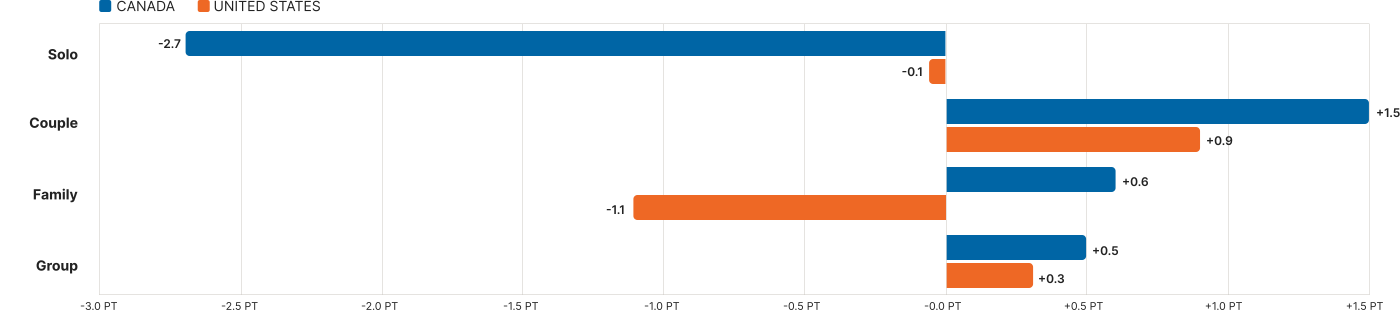
Change in share of bookings (percentage points)
Solo Travel Is Losing Ground in Canada, Much More So Than in the U.S.
Solo travel’s share of bookings fell sharply in Canada (−2.7pt) while staying nearly flat in the U.S. (−0.1pt) over the past year. Couples gained share in both markets, and family bookings moved in opposite directions, up in Canada, down in the U.S.
Families vs. Groups

Families prefer Manila, Orlando, Cancún.

Groups prefer to travel mostly domestic.
Family bookings lean heavily toward Manila, Orlando, and Cancún. A pattern consistent with visiting-friends-and-relatives travel and theme-park vacations. Group bookings stay the most domestic of the four types. Solo and Couple bookings look broadly similar to each other and to the overall market, concentrated on major domestic hubs with a moderate, growing international mix.

A Different Behaviour Across Traveller Types
Solo, couple, family, and group travel
| Traveller type | Advance in days (CA/U.S.) | Trip length in nights (CA/U.S.) | Intl share, YoY (CA/U.S.) |
|---|---|---|---|
| Solo | 22 / 22 | 4 / 7 | +6.0 pt / +6.5 pt |
| Couple | 39 / 40 | 4 / 7 | +4.5 pt / +4.5 pt |
| Family | 44 / 40 | 7 / 9 | +4.5 pt / -1.0 pt |
| Group | 51 / 51 | 4 / 7 | +4.0 pt / +4.6 pt |
Solo, Couple, Fam & Squad: The Booking Habits That Set Them Apart
Groups tend to book furthest in advance, reflecting the additional coordination required when travelling with more people. Solo travellers, by comparison, book closest to departure and typically take the shortest trips. One-way booking follows a similar pattern in both Canada and the U.S. Solo travellers are the most likely to book one-way, while groups are the least likely. Couples and families are essentially tied in Canada, while families are slightly more likely than couples to book one-way in the U.S. The exact shares are less important than the overall pattern.

Each Generation Travels Differently
Gen Z / Millennial / Gen X / Boomer

Gen Z Leads, Older Generations Retreat
Gen Z is redefining travel growth in North America, up 3.1 points in Canada and 4.2 in the U.S., while every other generation is pulling back slightly. Gen X in the U.S. shows the sharpest pullback, down 1.9 points, hinting at a generational divide in travel appetite that’s only set to widen. Millennials remain the largest generation traveling. Multi-generational family travel is holding steady, neither growing nor shrinking meaningfully.

Domestic Travel is Losing Ground in Both Countries
Gen Z / Millennial / Gen X / Boomer
| Metric | Canada | United States |
|---|---|---|
| Domestic, share of bookings | -4.8 pt | -6.4 pt |
Travellers Look Beyond Home
Domestic bookings dropped meaningfully year-over-year in both markets, down 4.8 points in Canada and 6.4 points in the U.S., with the U.S. decline notably steeper. The fact that this held true across every party type suggests it isn’t a niche shift driven by one traveler segment (say, solo vs. family trips) but a broad, structural move away from staying close to home.
Mexico/Caribbean/Central America and Asia-Pacific are picking up the slack, pointing to travellers trading domestic trips for accessible international ones, likely a mix of pricing, novelty, and post-pandemic wanderlust reasserting itself. Worth watching whether this trend holds or reverses if currency, cost, or geopolitical conditions shift.